
A BESS container can develop condensation even when its air conditioner is operating. Cooling controls air temperature and may remove some moisture, but it does not guarantee that every local surface remains warmer than the dew point of the air touching it. Moisture entry, cold surfaces, airflow, cycling, doors, and condensate drainage must be diagnosed as one event sequence.
Key takeaways
- Condensation depends on the local surface and nearby air dew point, not only room-average RH.
- Reconstruct the event across AC cycling, shutdown, restart, doors, drainage, and airflow.
- Trace every credible moisture-entry and water path before adding equipment.
- Temperature control and moisture removal are related but separate equipment duties.
- Evaluate dehumidification only from a verified load, condition, and interface set.
The controlling condition is local
Condensation becomes possible when a surface is colder than the dew point of the nearby air. ASHRAE describes this condition and notes that conductive paths can create cold spots whose actual minimum surface temperature is best established by testing (ASHRAE Handbook, Chapter 22).
This explains why a single return-air temperature or RH value can look acceptable while water appears elsewhere. The critical location may be:
- a panel near the evaporator discharge;
- a frame, fastener, or structural thermal bridge;
- a wall or door exposed to cold outdoor conditions;
- a cable entry or penetration;
- a low-airflow corner;
- a component with different thermal mass;
- a surface that remains cold after the cooling cycle changes.
The diagnosis must compare the suspected surface temperature with the air condition at the same location and time. A room sensor mounted elsewhere cannot prove that the surface was above the local dew point.
Why air conditioning does not close the moisture problem
1. Moisture continues to enter the enclosure
Outdoor air can enter through doors, penetrations, imperfect seals, pressure changes, service activity, or uncontrolled ventilation. Moisture can also enter on wet clothing, packaging, tools, or surfaces.
Where the project requires safety ventilation, review battery-room ventilation and dehumidification duties separately before assessing the moisture added by the established outdoor-air flow.
The relevant question is not whether the enclosure is described as sealed. It is how much moisture enters during actual operation and which events create the largest disturbance.
2. Cooling creates cold surfaces
The air conditioner removes sensible heat, and its coil may remove water when coil conditions permit. The same process can create cold supply air, cold metal, or local zones with low surface temperature. If humid air reaches one of those surfaces, condensation can occur even while the average container air is being cooled.
3. Moisture removal and cooling demand do not always coincide
An air conditioner is commonly controlled by temperature. When sensible cooling demand falls, the compressor may cycle off or reduce operation even though a moisture load remains. The resulting humidity control depends on the equipment, coil state, airflow, controls, and operating condition.
Do not infer latent performance from the existence of an AC unit. Review what the unit actually does during the event.
4. Door events create rapid changes
Opening a container can admit a volume of outdoor air and expose previously cool surfaces to a new moisture condition. A short event may be missed by slow logging intervals or a sensor far from the door, yet still create local surface wetting.
The recovery period matters as much as the steady state. Record when the door opened, outdoor conditions, how long it remained open, equipment state, and when local conditions returned to the project-defined range.
5. Shutdown and restart change the thermal sequence
After shutdown, different parts of the enclosure warm or cool at different rates. Restart can introduce cold air before moisture has been removed or can place humid air in contact with components that retained a lower temperature.
IEC 60068-2-30 addresses high humidity combined with cyclic temperature change in an environmental test procedure that generally produces condensation on specimen surfaces (IEC 60068-2-30:2025). This does not define a BESS field test or prove compliance. It does show why temperature-humidity transitions deserve separate attention from steady-state readings.
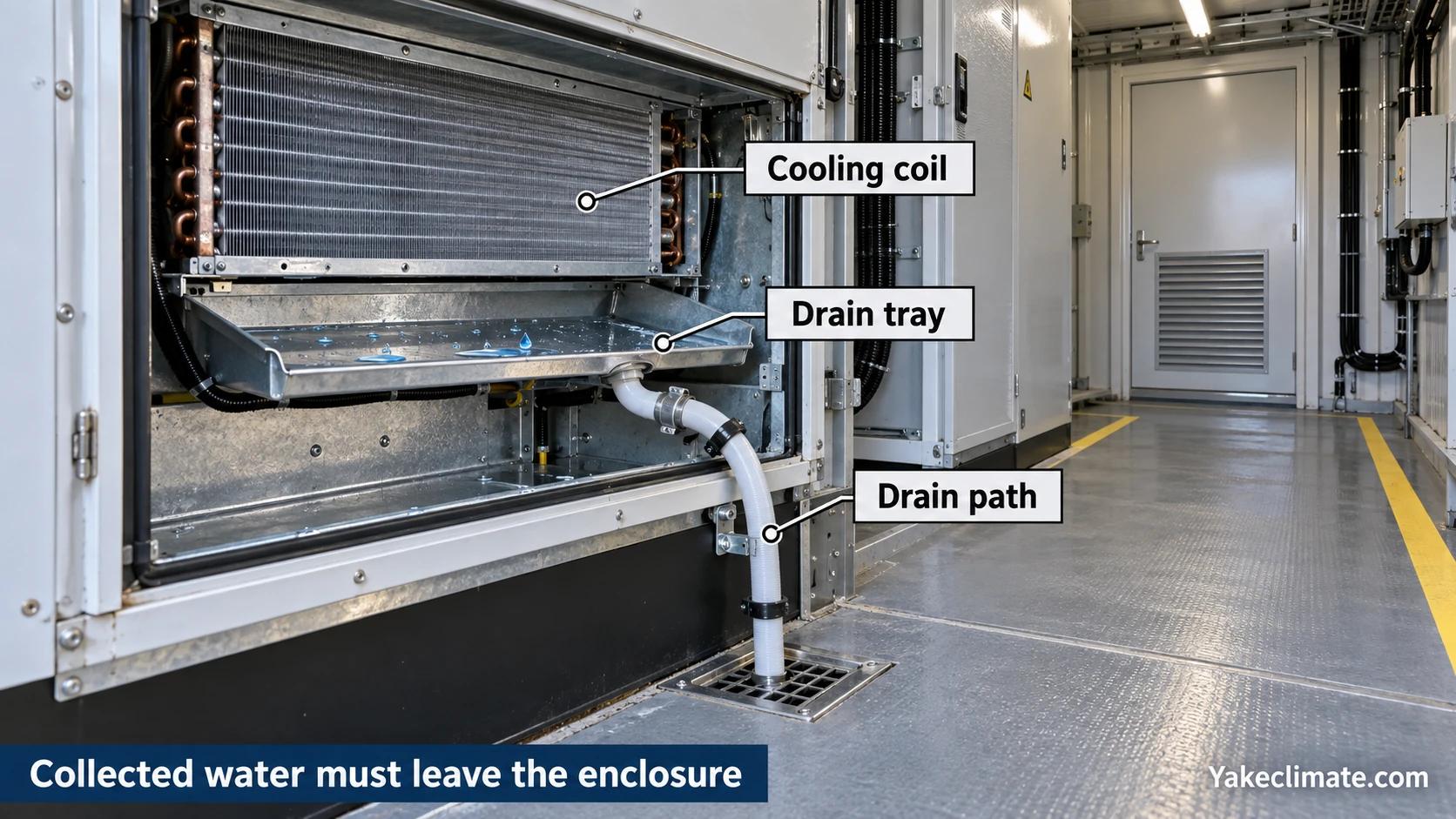
6. Condensate may be generated but not removed correctly
Water collected at a cooling coil still has to drain. Check drain slope, blockage, traps, pumps, insulation, re-evaporation, and leakage around the condensate path. Water found in the enclosure may originate from the drainage system rather than from a remote cabinet surface.
7. Airflow leaves local zones untreated
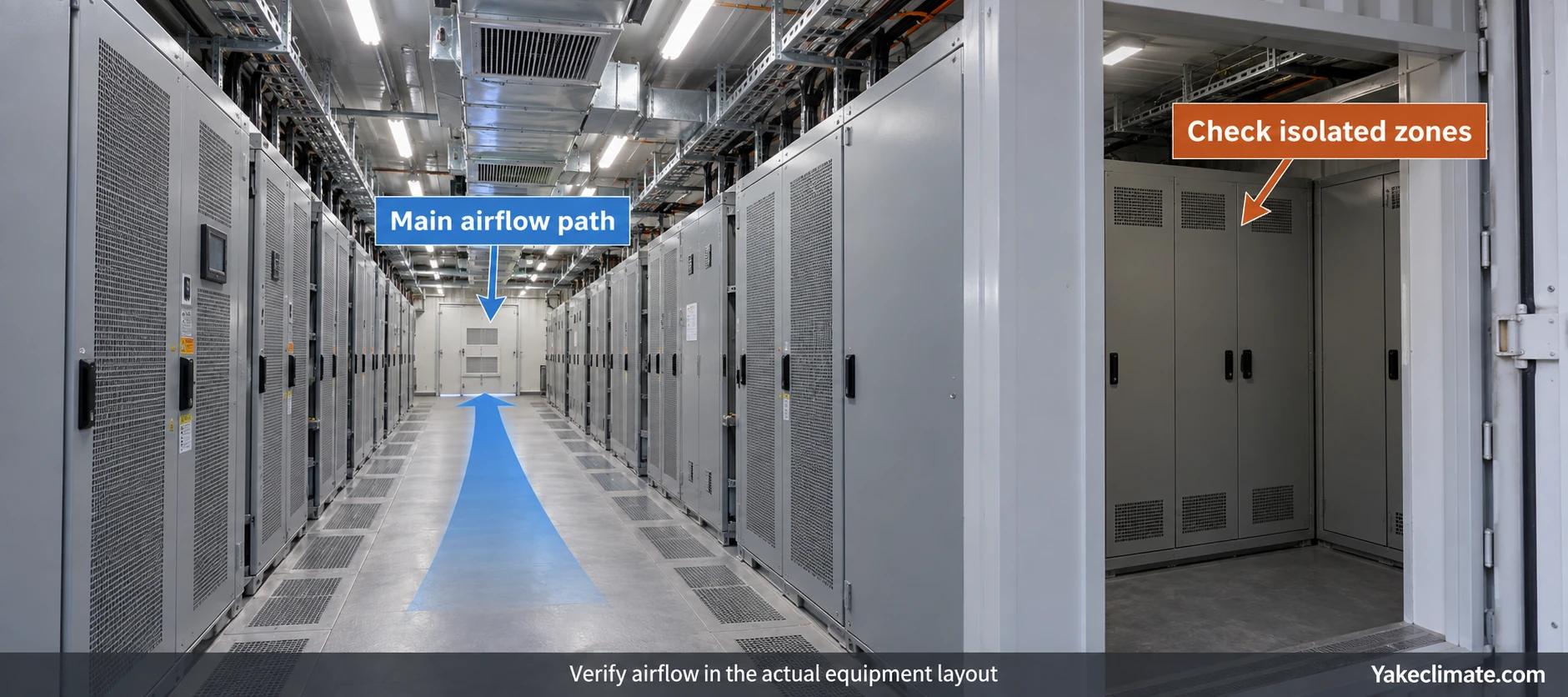
Supply and return paths can short-circuit. Racks, partitions, cable trays, or closed cabinet volumes can isolate air. The main HVAC loop may control one zone while another experiences a different dew point or surface temperature.
Use an AC-specific diagnostic sequence
Start with a short event record: first wet location, timestamped air/dew-point and suspected surface temperatures, outdoor condition, door and drain observations, and AC commands versus actual fan/compressor state. The general battery-cabinet condensation diagnostic guide covers the full water-source and enclosure inspection. Use the checks below to decide whether the AC sequence caused or failed to clear the local event, without duplicating that general checklist.
Step 1: Review the AC operating sequence
Check whether cooling and moisture removal were active at the same time as the event. Review coil and drain behavior, fan operation during compressor-off periods, setpoint changes, restart logic, and any control deadband relevant to the sequence.
Step 2: Verify local air distribution
Verify that conditioned air reaches the affected zone and returns through the intended path. Record obstructions and isolated cabinets. Airflow should be assessed in the actual equipment arrangement, not only in an empty container.
Step 3: Separate AC-related corrections from other causes
Match each action to its mechanism:
| Observed mechanism | Corrective direction | What it does not prove |
|---|---|---|
| Local moisture ingress | Seal, pressure, door, or operating review | That the whole enclosure needs more capacity |
| Cold bridge or cold supply exposure | Surface, insulation, or airflow review | That room RH is the only problem |
| Temperature-led AC cycling with remaining moisture | Controls and dedicated moisture-removal review | That any dehumidifier will fit the duty |
| Drainage failure | Drain path correction | That condensation formed on the affected equipment |
| Stagnant or isolated zone | Air-distribution correction | That circulation removes the water load |
| Transition event | Event-specific control and recovery review | That a steady-state setpoint will control the transition |
When dedicated dehumidification enters the discussion
Dedicated dehumidification should be evaluated when a verified moisture duty remains after avoidable ingress, drainage, cold-surface, and airflow problems are addressed, or when the AC operating sequence cannot maintain the project-defined moisture condition through critical events.
The evaluation needs:
- indoor and outdoor design and operating conditions;
- event time series, not only nominal setpoints;
- the relevant cold surfaces and local sensor positions;
- air volume, airflow route, outside-air and leakage information;
- door and service-event profile;
- required steady-state and recovery condition defined by the project team;
- existing AC performance and control sequence;
- power, drainage, controls, installation, and maintenance constraints.
A dehumidifier removes water from a defined airstream. It does not replace enclosure sealing, drainage, insulation, thermal management, electrical design, fire protection, or system controls.
The U.S. Department of Energy's 2022 Biennial Energy Storage Review reports a single operating case in Hawaii in which inadequate HVAC was identified as a significant BESS reliability issue and maintaining desired temperature and humidity was challenging (U.S. DOE). This observation is context-specific. It supports careful environmental-control review, not a universal failure rate or a prescribed equipment route.
For the underlying surface and measurement framework, see How to Define Dew Point Control Conditions for Battery Enclosures. The broader BESS application boundary is available on the Energy Storage application page.
FAQ
Frequently asked questions
Does an air conditioner dehumidify a BESS container?
It can remove moisture when air and coil conditions produce condensation and the water drains correctly. Actual moisture removal depends on equipment and operating state. Temperature control alone does not prove continuous humidity control.
Can a container condense if its average RH is within target?
Yes. A local surface can be colder than the room air and below the dew point of nearby air. Sensor position and event timing can also hide the condition.
Should the first response be a lower AC temperature setpoint?
Not automatically. Lowering air temperature may create colder surfaces and does not identify the moisture source. Reconstruct the event and compare local surface and dew-point conditions first.
Will a dehumidifier guarantee no condensation?
No unconditional guarantee is valid. Equipment can remove a defined moisture duty, but results also depend on ingress, surface temperatures, airflow, controls, installation, and operation.
Treat condensation as an event, not a label
An AC-equipped container still has moisture paths, cold surfaces, local airflow, drainage, and operating transitions. Diagnose which mechanism created the water, correct the source where possible, and define any remaining dehumidification duty from measured conditions.
Yakeclimate designs and manufactures industrial dehumidification equipment for complex climate applications. To review equipment fit, share the condensation event, operating data, and system interfaces.


