
Greenhouse humidity control should begin with a moisture balance, not an equipment list. Identify where water enters the air, when removal becomes insufficient, and which crop or structural surfaces approach the local dew point. Only then can ventilation, heating, air movement, and mechanical dehumidification be assigned useful roles.
This order matters because the same room-level relative humidity can represent different operating risks. A warm daytime greenhouse with active ventilation is not the same problem as a cooling greenhouse after sunset. A single sensor above the crop may also miss colder leaves, glazing, frames, or stagnant canopy zones.
Key takeaways
- Define the moisture sources and risk periods before discussing equipment.
- Compare local cold surfaces with the nearby air dew point, not only a room RH value.
- Ventilation, heating, air movement, and dehumidification perform different functions.
- Treat uncontrolled surface condensation as a risk, not as usable moisture-removal capacity.
- Evaluate equipment only after the remaining duty and air-distribution path are defined.
Start with four questions
Before changing a setpoint or comparing equipment, answer four questions:
- Where is moisture entering the greenhouse air? Consider crop transpiration, irrigation, wet floors and surfaces, incoming outdoor air, and process activities.
- When does moisture accumulate? Separate daylight operation, the transition around sunset, the night period, dawn, irrigation events, and weather changes.
- Which surfaces are most likely to become cold? Check leaves, flowers, glazing, frames, pipes, perimeter zones, and locations exposed to the night sky or thermal bridges.
- What removal routes are actually available during the risk period? Ventilation, heating, air circulation, surface drainage, and mechanical dehumidification do different jobs.
These questions turn a vague complaint about high RH into an engineering problem that can be measured.
Build the moisture balance before selecting a method
Humidity rises when water vapor enters the greenhouse air faster than it leaves or condenses onto surfaces. Uncontrolled condensation on leaves or structures is a risk and must not be credited as usable moisture-removal capacity. Only a designed, drained, and verified condensation route can be treated as a controlled removal path. The relevant balance changes with crop state, weather, ventilation position, irrigation practice, temperature, and operating schedule.
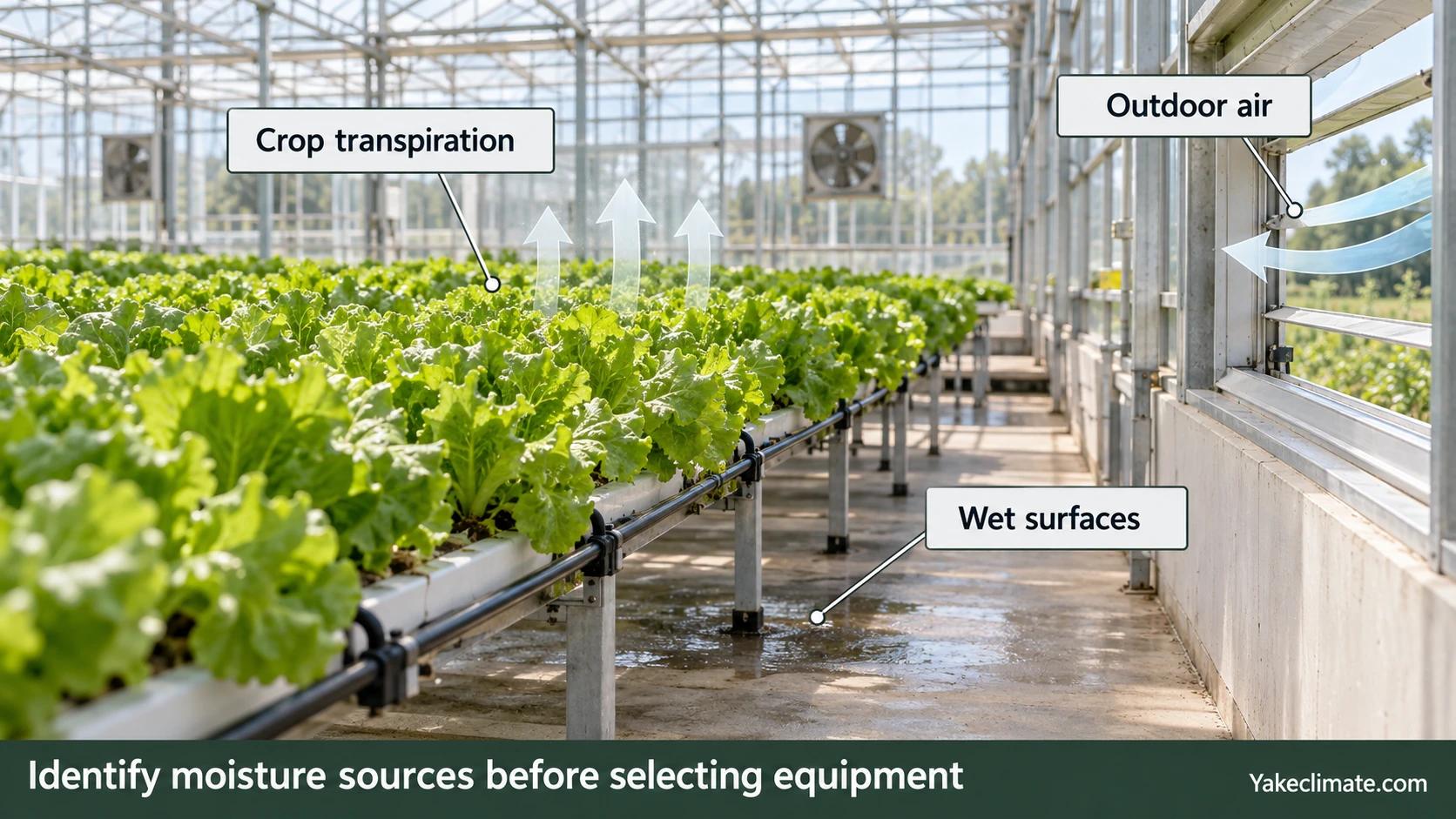
Research on greenhouse humidity modeling treats crop transpiration, ventilation, and cover condensation as connected parts of the balance rather than isolated variables. It also shows why one humidity value cannot be linked to every crop response without considering weather and leaf area (Stanghellini and de Jong).
For project diagnosis, organize the balance as a load ledger:
| Moisture path | What to record | Why it matters |
| Crop and growing media | Crop stage, canopy condition, irrigation timing, wet surfaces | Moisture generation changes over time and by zone |
| Outdoor air | Outdoor temperature and humidity during the same operating period | Ventilation can remove or introduce water vapor |
| Leakage and doors | Door cycles, gaps, pressure relationships, wind exposure | Uncontrolled air exchange can change the load |
| Unintended condensation and drainage | Where water appears, how long surfaces remain wet, drainage behavior | Visible water identifies a local surface problem and is not a usable removal credit |
| Mechanical removal | Equipment operating state, airflow path, run time, defrost or regeneration state | Nameplate capacity does not describe actual removal at every condition |
For the distinction between air and growing-medium readings, see root-zone moisture versus air humidity.
Do not convert floor area directly into dehumidifier count. Two greenhouses with the same area can have different crops, envelopes, ventilation rates, temperatures, and operating constraints. The water load and the equipment duty must be established from the actual condition.
Trace the water before diagnosing condensation
When a plant or surface is wet, record how water arrived and when. For a wet plant, candidate paths include direct watering or an overhead drip. For a wet floor or structure, record visible water and drainage. A wet plant is not necessarily where condensation formed: water condensed on the greenhouse covering can drip onto plants (UMass Extension). Treat each route as an observation, not a diagnosis.
For water on foliage, the leaf water-origin check separates direct dew from irrigation and overhead delivery. For a wet overhead line, the greenhouse pipe diagnostic distinguishes exterior condensation, a line leak, and drips arriving from above before attributing the water to the house-wide humidity balance.
For the event, note:
- direct watering or overhead dripping, with date and time if known;
- puddles, flow direction, and drainage observations; record “unknown” when unavailable;
- whether the surface itself could have condensed water: compare its temperature with the dew point of nearby air during the event (UF/IFAS).
If event-time observations are missing, a current reading cannot establish what happened earlier. A surface now above the dew point does not rule out earlier condensation, and a drip path does not exclude condensation or another source. Keep unresolved paths visible before interpreting the observation.
For wet mechanical surfaces, keep the whole-greenhouse moisture balance separate from the first-wet-point diagnosis. A wet cabinet or drain calls for the equipment-cabinet water-origin check; beads or outlet drips on an air duct call for the greenhouse duct water-path check. Neither observation by itself establishes a larger water-removal duty.
Condensation dripping from the greenhouse covering creates two separate observation questions: where did the water land, and could the route carry material from soil or plant debris? UMass Extension notes that covering condensation can wet plant surfaces and spread pathogens by splashing soil and plant debris (UMass Extension). That mechanism describes a possible wetting and splash route; a visible drip does not show that a plant is infected or establish how severe any damage is. Record the drip source, landing point, and whether the drops struck soil or plant debris. For a separate record of how long foliage stayed wet, see leaf-wetness duration in a greenhouse. Leaf-wetness duration documents surface wetness; it is not a disease diagnosis.
For water traced to the covering, the roof water-path guide follows where condensate falls or drains. When the wet face, material layer or joint is uncertain, the glazing-location check helps identify the responsible inspection. Neither route alone establishes a whole-greenhouse dehumidification duty.
Sources: UMass Extension, “Reducing Humidity in the Greenhouse” — distinguishes covering condensation and drips onto plants.
UF/IFAS, “Greenhouse Ventilation” — explains condensation below nearby-air dew point.
Why relative humidity alone is not enough
Relative humidity is temperature-dependent. When air cools without losing water vapor, RH rises. Condensation becomes possible when a surface is colder than the dew point of the air touching it.
That local wording is important. The surface temperature and the nearby air condition must refer to the same place and time. A room sensor can report an acceptable value while a leaf, glazing panel, frame, or corner is colder. University of California guidance describes how night cooling can make greenhouse structures and plant surfaces the coldest local objects and how air movement around the canopy can influence condensation risk (UC Agriculture and Natural Resources).
Use RH as an operating signal, but diagnose condensation with three linked observations:
- local air temperature and humidity near the risk zone;
- the temperature of the relevant cold surface;
- the time sequence before, during, and after the event.
The objective is not to publish a universal safety margin. It is to identify which surface controls the risk and how the local condition changes during real operation.
For surface-specific diagnosis, follow the greenhouse condensation guide alongside the air-humidity assessment.
Assign each control method a specific job
Ventilation exchanges indoor and outdoor air
Ventilation can remove moisture when the entering outdoor air carries less water vapor than the air being exhausted. Outdoor RH by itself does not answer that question because RH changes with temperature. Compare indoor and outdoor moisture state for the same period.
The University of Florida IFAS greenhouse ventilation guidance explains that winter ventilation removes warm, moisture-laden greenhouse air, but also increases the heating required to restore temperature. This makes ventilation a combined moisture and heat decision.
Ventilation becomes less useful when outdoor air is too humid, when wind or temperature conditions limit controllability, or when opening the greenhouse conflicts with heat or CO2 retention. It may still remain part of the strategy, but it cannot be assumed to solve every hour of the load.
For a deeper method comparison, see Ventilation or Dehumidification for a Greenhouse?.
Heating changes RH but does not remove water by itself
Heating raises air and surface temperatures and can reduce relative humidity. It can also help keep a critical surface above the local dew point. The water vapor remains in the greenhouse unless it is removed through controlled ventilation, a designed condensation-and-drainage process, or dehumidification. Uncontrolled surface condensation is not a control method.
Treat heating as a temperature and condensation-control action, not as automatic moisture removal. If heated air is later cooled without losing water, the RH rises again.
Air movement reduces local differences
Circulation fans can mix air, improve contact between conditioned air and the crop zone, and reduce stagnant pockets. They can also help bring warmer air to cold surfaces. They do not remove water from the greenhouse.
Air movement is therefore a distribution tool. It supports ventilation, heating, or dehumidification, but it cannot substitute for a water-removal route when the vapor load remains in the space.
Mechanical dehumidification removes water within the controlled space
Mechanical dehumidification becomes relevant when the moisture load persists during periods when ventilation is unavailable, unstable, or operationally costly. It may also be useful when the greenhouse must retain heat or CO2, or when tighter control is required during a defined night or transition period.
Its role should be stated narrowly: remove a defined moisture duty under defined air conditions and deliver air through a workable distribution path. It does not correct every source of water ingress, cold bridging, poor circulation, drainage failure, or control conflict.
Where mechanical removal is appropriate, compare dehumidifiers for commercial greenhouses against the required moisture duty and installation constraints.
Use a condition-based control route
The following sequence keeps method selection tied to the problem:
| Decision | If the answer is yes | If the answer is no |
| Is the risk concentrated around sunset, night, dawn, irrigation, or a weather event? | Diagnose that period separately | Build a full-day moisture profile |
| Can outdoor air remove water vapor during the risk period? | Evaluate ventilation capacity and operating cost | Do not rely on ventilation as the primary removal route |
| Can surface temperatures be raised without creating unacceptable operating effects? | Coordinate heating with the removal route | Focus on moisture removal and local surface conditions |
| Are stagnant zones or cold surfaces driving local events? | Correct airflow and measurement coverage | Continue with the room-level load review |
| Does a material moisture load remain after feasible controls? | Define a mechanical dehumidification duty | Do not add equipment without another verified reason |
The result is often a combination. Ventilation can handle favorable outdoor periods. Heating can protect surfaces during a transition. Air movement can reduce spatial differences. Mechanical dehumidification can address the remaining duty when the other routes are constrained.
Measure the risk period, not only the average day
A useful monitoring plan captures transitions. Log the hours before and after sunset, control-state changes, irrigation events, vent position, heating calls, and any visible condensation.
Use more than one air measurement location when the greenhouse has different crop zones, perimeter conditions, heights, or airflow paths. Research from Wageningen notes that humidity around a crop can be spatially non-uniform and that air distribution influences practical dehumidification performance (Wageningen University & Research).
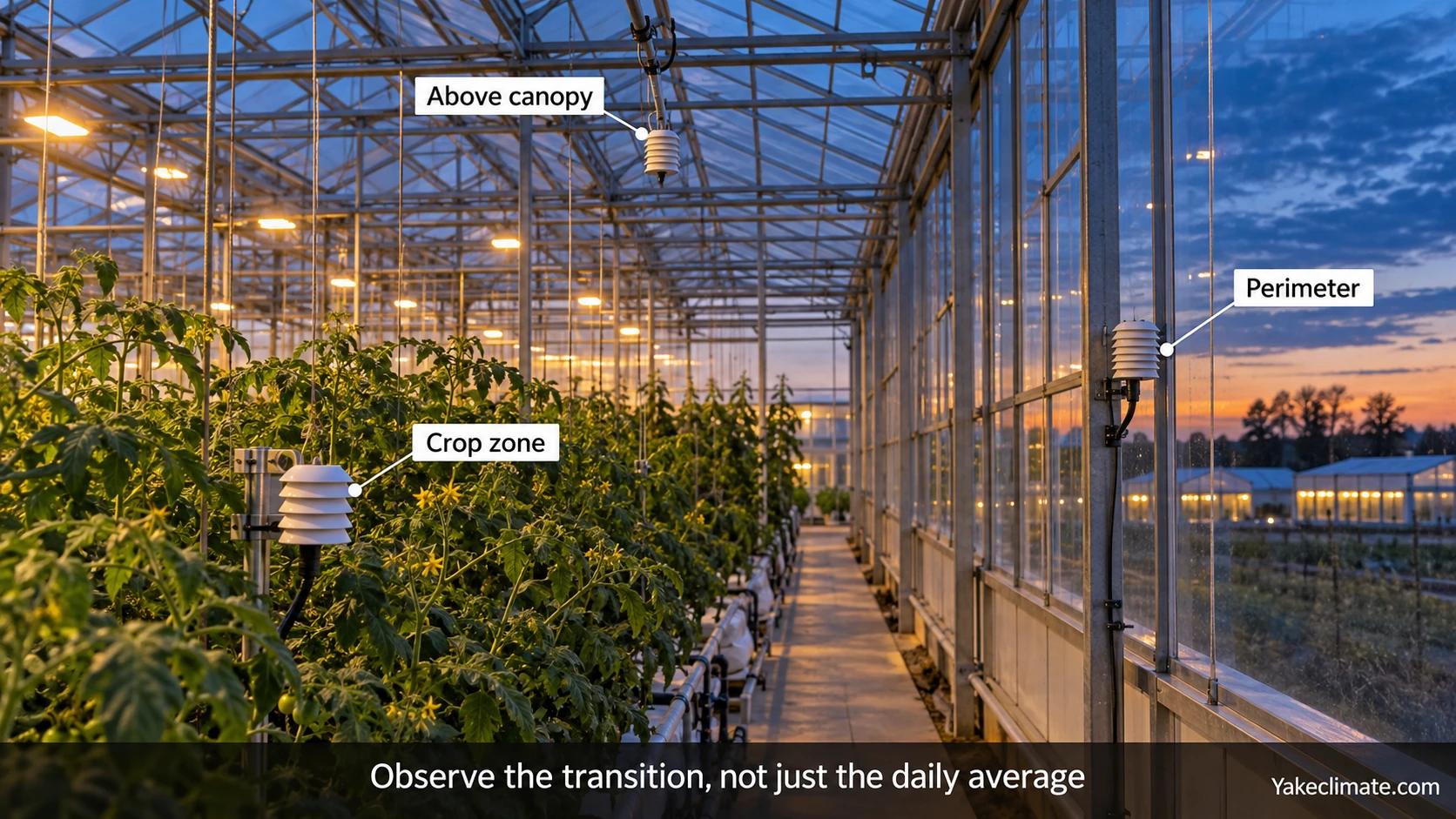
Pair air data with observations of the likely cold surfaces. The goal is to determine whether the dominant problem is:
- excessive water entering the space;
- insufficient removal during a specific period;
- a cold local surface;
- weak air distribution;
- a control sequence that reacts too late;
- or a combination of these conditions.
The nighttime greenhouse humidity guide provides a more focused sequence for post-sunset events.
Information needed before discussing equipment
An equipment review needs a defined operating condition. Prepare:
- greenhouse dimensions and compartment layout;
- crop type and stage, with irrigation schedule and known wet-surface sources;
- indoor target condition defined by the project team;
- outdoor design and operating periods relevant to the problem;
- time-series air temperature and humidity from representative zones;
- likely cold-surface temperatures or event observations;
- ventilation, heating, circulation, and existing dehumidification operation;
- air distribution constraints and available installation space;
- electrical, drainage, regeneration-energy, maintenance, and control-interface requirements;
- the required recovery behavior after doors, irrigation, or other disturbances.
These inputs do not complete the greenhouse climate design. They define the part of the moisture problem that an equipment manufacturer can evaluate.
Use the greenhouse climate-control responsibility matrix to agree who owns each target, command and alarm before connecting the equipment.
Crop and stage change the equipment handoff. For example, cucumber humidity work separates day and night operation, canopy airflow and surface wetness; lettuce humidity work starts by separating propagation from production and distinguishing tipburn from wet lower leaves. Neither crop guide supplies a universal RH target or substitutes for the actual facility measurements.
FAQ
Frequently asked questions
Is a high RH reading enough to justify a dehumidifier?
No. First confirm when the condition occurs, what adds moisture, whether the reading represents the risk zone, and which removal routes are available. Mechanical dehumidification is justified by a defined remaining duty, not by one RH value.
Can circulation fans solve greenhouse humidity?
Fans can reduce local air differences and improve the delivery of conditioned air. They do not remove water vapor. A separate removal route is still required when the moisture balance remains positive.
When is ventilation effective for dehumidification?
When the incoming air has a lower water-vapor content than the exhaust air and the thermal, CO2, weather, and control consequences are acceptable for the project.
Why does condensation appear even when the room RH looks acceptable?
The measured air may not represent the air touching the coldest surface. Condensation risk is local and depends on the surface temperature, nearby dew point, airflow, and timing.
Define the condition before the equipment
Greenhouse humidity control is a system decision built from a moisture balance, cold-surface risk, operating period, and feasible removal routes. Mechanical dehumidification fits when a defined moisture duty remains after ventilation, heating, and air-distribution constraints are understood.
Yakeclimate designs and manufactures industrial dehumidification equipment for complex climate applications. To review equipment fit, share your operating conditions rather than a floor area alone.
RYDZ-40S — Industrial Ceiling Dehumidifier — 960 L/24h at 30 °C / 80 % RH · 10,000 m³/h · 5–38 °C Check the airflow path, obstructions and representative crop-zone conditions for the proposed layout. The nominal airflow does not establish coverage of a wide bay or the absence of stagnant zones.
Related technical reading
For equipment-route comparisons, trace the water and heat paths in heat-recovery arrangements before comparing direct-air and duct-connected layouts. Persistent wet areas also need a location-specific assessment: distinguish algae on wet surfaces from mold on structural materials.
For the wider application context, return to agricultural humidity control.


